Example of sampling material. The collected leaves are stored in labelled paper bags (top right). These bags are then placed in a zip-lock plastic bag containing silica gel to control humidity (top left).
As European forests face increasing pressure from climate change, understanding the genetic diversity of our tree populations has never been more important. Genetic diversity is the raw material of adaptation: it enables tree populations to cope with changing environmental conditions, resist emerging threats, and maintain healthy and resilient forest ecosystems over the long term.
To better understand and safeguard this diversity, the MigFoRest project has launched an ambitious genetic characterisation campaign across its pilot territories, focusing on ten tree species of major ecological and silvicultural importance:
- Silver fir (Abies alba)
- Greek fir (Abies cephalonica)
- Spanish fir (Abies pinsapo)
- Sessile oak (Quercus petraea)
- Pedunculate oak (Quercus robur)
- Downy oak (Quercus pubescens)
- Small-leaved lime (Tilia cordata)
- Large-leaved lime (Tilia platyphyllos)
- Wild service tree (Sorbus torminalis / Torminalis glaberrima)
- True service tree (Sorbus domestica / Cormus domestica)
These species were chosen either because they are widespread native species playing a key role in European forests, such as oaks and firs, or because they show strong potential for future climate resilience, as is the case for lime and Sorbus species.
Between May and early July, MigFoRest partners carried out extensive field sampling within their regional pilot territories:
- INBO: Kempen (Belgium)
- CRA-W and SRFB: Condroz and Southern Ardennes (Belgium)
- FVA: Schwäbisch-Fränkischer Wald and Oberrheingraben (Germany)
- Néosylva: Petite Charnie, Sarthe (France)
- ONF: Compiègne Forest, Oise (France)
By the end of this first sampling season, over 1,700 leaf samples had been collected from local tree populations across the project area.
Looking beyond local populations
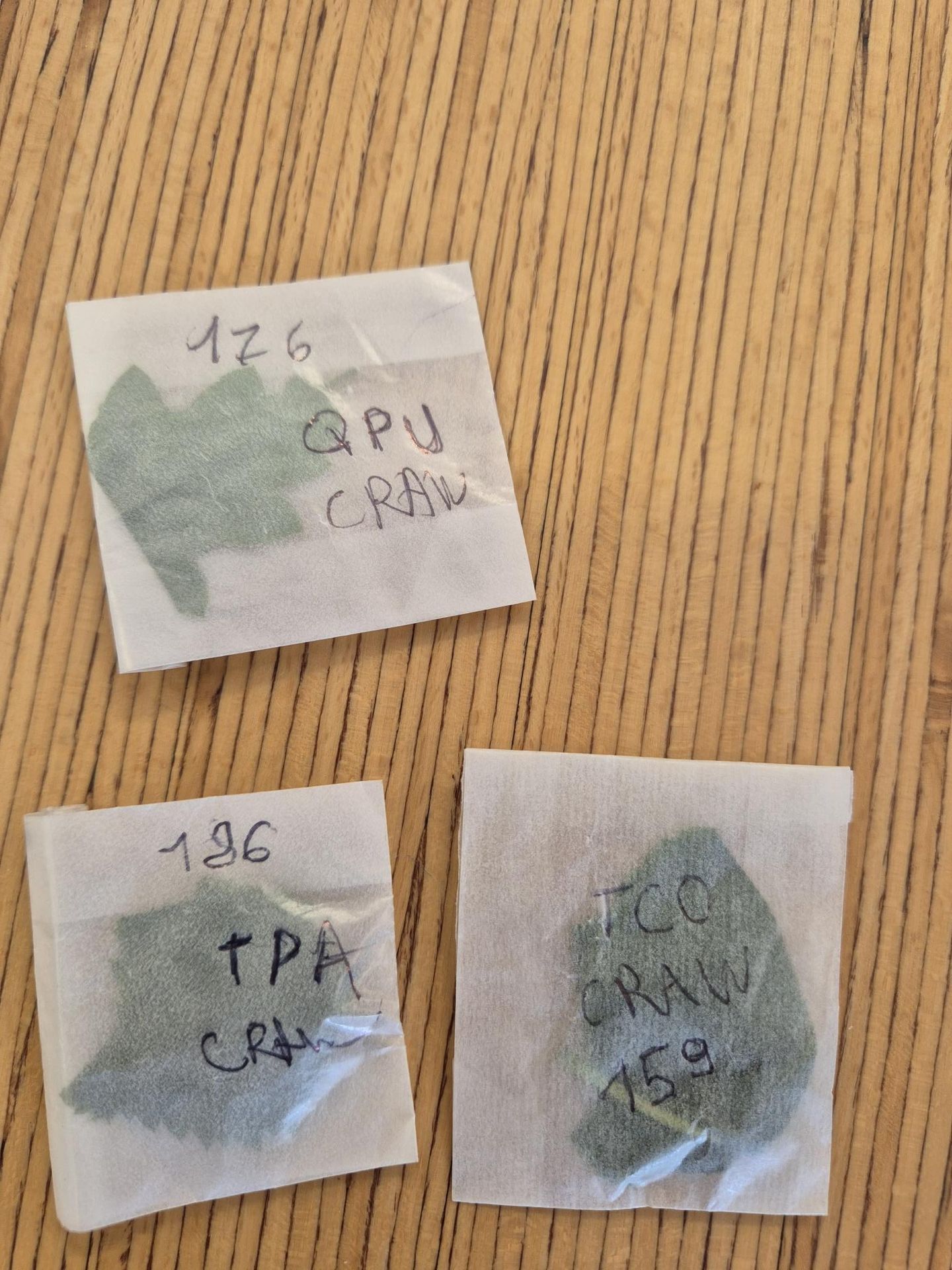
The sampling effort is not limited to local forest stands. In parallel, seedlings originating from a wide range of imported provenances have also been collected and characterised.
These provenances come from regions whose current climate resembles the climate expected in north-western Europe by the end of the century. They include populations from southern European countries such as Spain and Portugal, as well as from central and eastern European countries including Bulgaria, Hungary, Romania and the Czech Republic.
By comparing local and non-local populations, MigFoRest aims to improve our understanding of the genetic relationships between existing forest resources and potential sources for assisted migration.
A collaborative European research effort
Once collected, the samples are distributed among the project's research partners according to their areas of expertise:
- Abies species are analysed by FVA
- Sorbus species are analysed by CRA-W
- Tilia species are analysed by INBO
- Quercus species are analysed jointly by all partners (including ONF)
Next steps
Additional sampling will be carried out this autumn using dormant buds instead of leaves, followed by a final campaign next spring.
Meanwhile, genetic analyses continue throughout the year. The process involves extracting DNA from the collected material, amplifying it using specific genetic markers known as microsatellites, and analysing the resulting DNA fragments through capillary electrophoresis to generate a genetic profile for each individual tree.
The raw data must then undergo extensive quality control and statistical processing before meaningful conclusions can be drawn. The complete genetic database is expected to be established by the end of 2027, after which the results will be analysed and incorporated into scientific publications and project recommendations.
Why perform genetic analyses?
Each leaf sample contains valuable genetic information. By analysing these samples, researchers can establish a unique genetic profile for each sampled individual. These profiles can then be compared within and between populations, as well as among different regions of origin, to estimate levels of relatedness and genetic distance.
These analyses will help answer several important questions:
- How genetically diverse are our local populations? Is the observed diversity sufficient, or is there evidence of limited diversity and possible inbreeding?
- What is the level of genetic diversity within imported seed lots? Are they sufficiently diverse, or are the individuals too closely related?
- How genetically similar or different are candidate provenances compared with local populations?
- Will genetic exchange occur between local and introduced populations? Although this can only be assessed once plantations reach reproductive maturity, characterising populations today will provide the baseline needed to monitor gene flow in the future.
Understanding diversity today to prepare forests for tomorrow
It is important to note that MigFoRest focuses on assessing genetic diversity, not directly identifying traits such as drought tolerance or susceptibility to late frosts. These characteristics are controlled by many genes, whose functions are not yet fully understood in most forest tree species.
However, combining genetic analyses with long-term field monitoring will provide valuable insights into how different provenances perform under changing environmental conditions. MigFoRest is thus building the knowledge needed to support informed decisions regarding forest reproductive material and climate adaptation strategies.